Normal 0 21 false false false FR X-NONE X-NONE /* Style Definitions */ table.MsoNormalTable {mso-style-name:"Tableau Normal"; mso-tstyle-rowband-size:0; mso-tstyle-colband-size:0; mso-style-noshow:yes; mso-style-priority:99; mso-style-qformat:yes; mso-style-parent:""; mso-padding-alt:0cm 5.4pt 0cm 5.4pt; mso-para-margin-top:0cm; mso-para-margin-right:0cm; mso-para-margin-bottom:10.0pt; mso-para-margin-left:0cm; line-height:115%; mso-pagination:widow-orphan; font-size:11.0pt; font-family:"Times New Roman","serif"; mso-ascii-font-family:"Times New Roman"; mso-ascii-theme-font:minor-latin; mso-fareast-font-family:"Times New Roman"; mso-fareast-theme-font:minor-fareast; mso-hansi-font-family:"Times New Roman"; mso-hansi-theme-font:minor-latin; mso-bidi-font-family:"Times New Roman"; mso-bidi-theme-font:minor-bidi;} La Structure du Rubāb Afghan
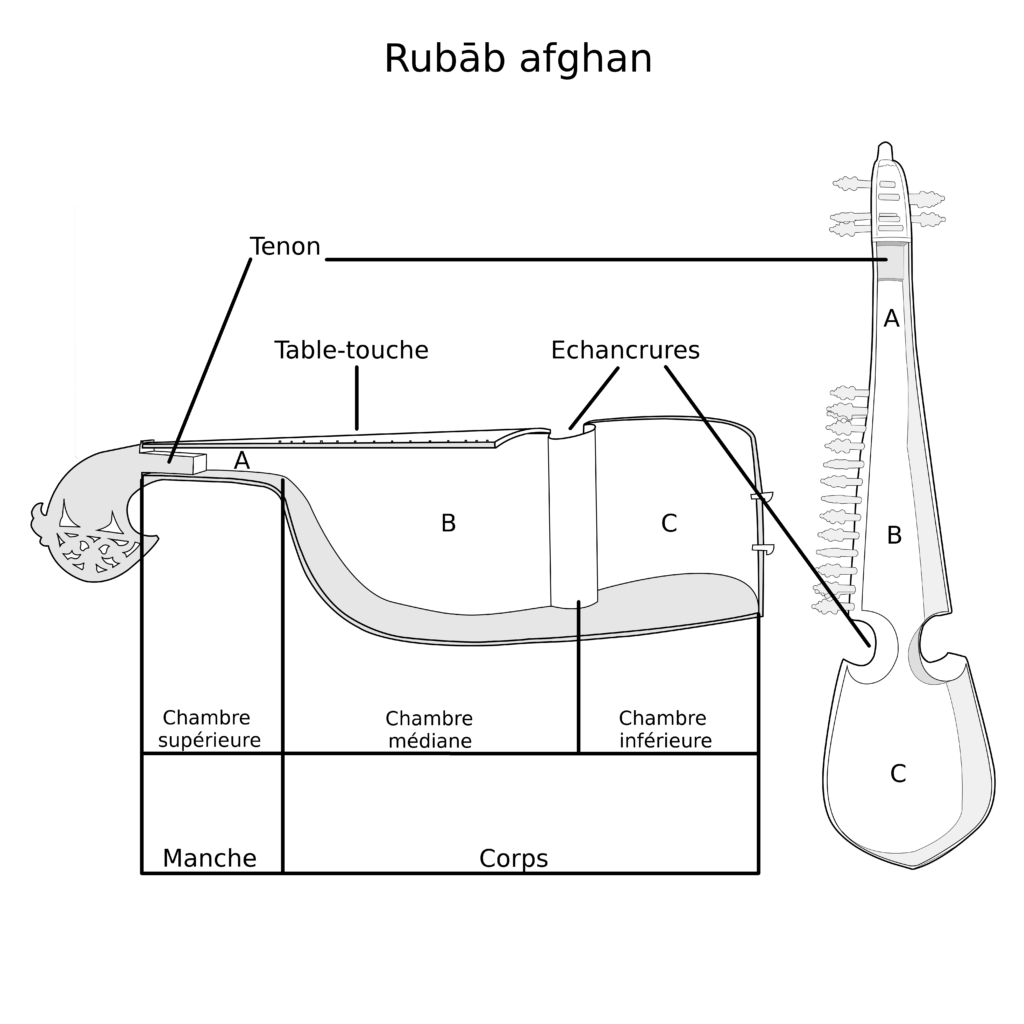
The structure of the Afghan rubāb consists of a carved and hollowed-out piece of mulberry. The cavity formed by the internal structure of the instrument is made up of three chambers or hollow volumes. This cavity is complex in nature, as explained in the thesis (The Afghan rubāb, a historical, musicological and organological study of a Central Asian lutepresented by Sylvain Roy and defended on 12 December 2017, at the University of Paris Nanterre, under the supervision of Professor Emeritus Jean During). The three chambers of the instrument's cavity play a direct part in its timbre, and are represented here by the letters A, B and C :
La chambre A, ou dite « supérieure », a pour fonction première d’alléger le manche. Même si elle est d’un volume peut important, elle participe au timbre de l’instrument. Cela n’est probablement pas significativement audible, mais son action sur l’acoustique est à prendre en compte.
La chambre B, nommé « médiane », est étroite et profonde, elle joue un rôle important dans le timbre et l’acoustique de l’instrument.
La chambre C, dite « inférieure », est la plus importante. Elle est souvent aussi large que profonde. C’est sur cette dernière qu’est tendue la table d’harmonie en peau. C’est la chambre qui joue un rôle premier dans l’élaboration du timbre et de l’acoustique de l’instrument. Les chambres B et C communique au travers d’une étroite ouverte, citée au niveau des échancrures latérales. C’est ces dernières qui confèrent au rubāb afghan cette apparence qui évoque le corps d’un instrument à cordes frottées.
 English (UK)
  Français